

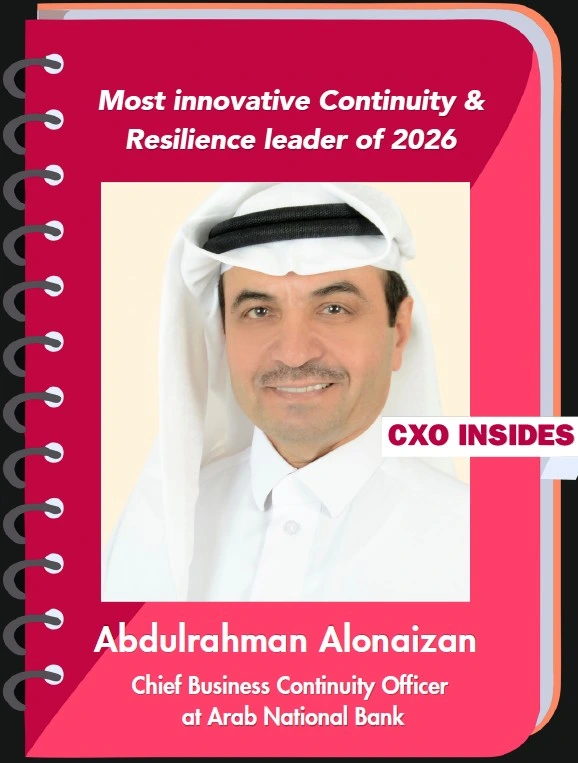
Designing Continuity as a Competitive Advantage: The Strategic Lens of Abdulrahman Alonaizan at Arab National Bank
There are leaders who respond to disruption, and then there are those who prepare for it long before it arrives. Abdulrahman Alonaizan belongs firmly to the latter. Over a career that spans more than three decades, he has quietly shaped how resilience is understood within modern banking. Not as a defensive function, but as a strategic advantage.
At Arab National Bank, his role as Chief Business Continuity Officer is not confined to safeguarding operations. It is about embedding a level of readiness that allows the organization to move forward with confidence, even when conditions shift unexpectedly. His work reflects a clear belief that resilience, when designed well, can become a source of strength rather than a response to weakness.
From Control to Confidence: Redefining Leadership in Continuity
Abdulrahman’s approach to leadership moves away from control-driven systems and toward confidence-driven cultures. He does not view continuity as a checklist or compliance requirement. Instead, he treats it as an organizational behavior that must be cultivated over time.
He places strong emphasis on clarity in decision-making and ownership at every level. Teams are not just informed about risks; they are trained to think ahead and act with purpose. As he puts it, “True readiness comes when people know what to do without waiting to be told.”
This shift from instruction to empowerment has allowed teams within the bank to operate with greater independence while staying aligned with broader goals. His leadership style is calm but deliberate, focused on building trust and reducing uncertainty before it has a chance to grow.
Anticipating the Next Disruption
One of Abdulrahman’s defining strengths is his ability to look beyond immediate risks and focus on what lies ahead. In a sector where change is constant, he has made anticipation a core part of his strategy.
Under his guidance, Arab National Bank has strengthened its ability to monitor emerging threats and adapt its systems accordingly. Whether it is digital risk, operational dependency, or external shocks, his approach ensures that planning evolves in real time.
He often highlights that resilience cannot rely on past experiences alone. “What protected us yesterday may not protect us tomorrow,” he notes. This mindset drives continuous evaluation and improvement, ensuring that the organization remains prepared for new types of challenges.
Turning Pressure into Progress
Throughout his career, Abdulrahman has faced moments that tested not only systems, but also leadership itself. Market volatility, global uncertainties, and rapid technological shifts have all required quick thinking and steady execution.
What sets him apart is his ability to convert pressure into progress. Instead of focusing on what went wrong, he focuses on what can be strengthened. Each challenge becomes an opportunity to refine processes, improve coordination, and enhance response mechanisms.
These moments have led to significant advancements in how continuity is managed within the bank. Faster recovery frameworks, stronger communication channels, and more agile response systems are all part of the evolution he has driven.
Building for Scale, Not Just Survival
Looking forward, Abdulrahman’s vision is not limited to maintaining stability. He is focused on building systems that can scale with growth while remaining resilient under pressure.
He believes that continuity must grow alongside the organization, adapting to new markets, technologies, and customer expectations. This requires investment not only in systems, but also in people. Training, awareness, and skill development are central to his long-term strategy.
“Resilience must expand as the organization expands,” he explains. “It cannot remain static while everything else evolves.” This perspective ensures that preparedness remains relevant, no matter how the business landscape changes.
Creating Value Beyond Risk Management
While continuity is often associated with risk reduction, Abdulrahman views it as a value-creating function. By ensuring stability, he enables the organization to focus on growth without hesitation.
His work supports not only operational strength, but also customer trust. Clients and stakeholders benefit from the assurance that services will remain consistent, even in uncertain conditions. This reliability becomes a competitive differentiator in a crowded financial market.
Beyond the organization, his influence contributes to raising standards within the banking sector. By promoting structured and forward-looking continuity practices, he encourages a broader shift toward resilience as a priority rather than an afterthought.
In a world where disruption is no longer an exception, Abdulrahman Alonaizan continues to demonstrate that preparedness is not about reacting faster. It is about thinking earlier, planning smarter, and building systems that hold steady when everything else is in motion.
The CXO Time Magazine is one of the leading global platforms for leaders and entrepreneurs to showcase their stories.





About Us
The CXO Time Magazine is one of the leading global platforms for leaders and entrepreneurs to showcase their stories.
Reach us: info@thecxotime.com